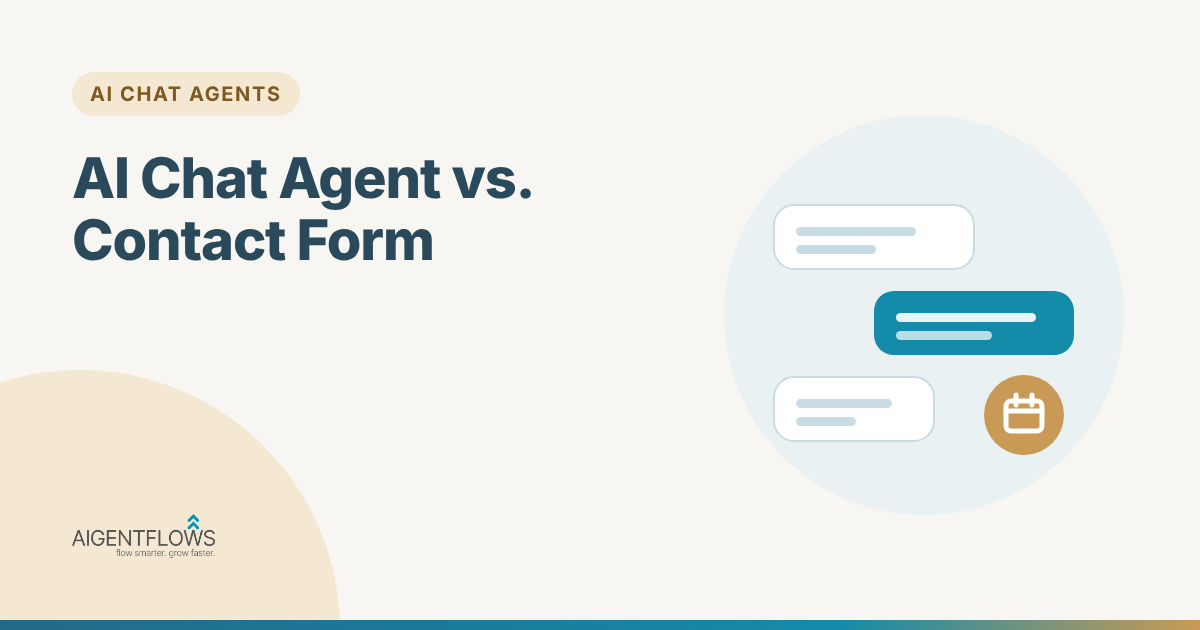
- A contact form collects a request and makes the visitor wait. An AI chat agent answers while they are still on your site.
- It answers common questions, asks your qualification questions and books a call directly into your calendar.
- Only 37% of US companies answered a new web lead within an hour, so instant answers stand out.
- Keep the form as an option; the chat agent is for visitors who want an answer now.
The problem with "we will get back to you"
A visitor lands on your website, likes what they see and has a question. The only option is a contact form. They fill it out, click send and leave. Then they visit the next provider's site. By the time your team calls back, the visitor may have already booked someone else. Harvard Business Review found that only 37% of US companies responded to a web lead within an hour (Source: Harvard Business Review, 2011).
What an AI chat agent does
An AI chat agent is an assistant on your website that holds a real conversation in writing. Unlike the old button-based chatbots, it understands free text and answers based on your services, areas and rules.
- Greets and answers. Common questions about services, areas, hours and process get an answer right away.
- Qualifies. It asks your questions, one at a time: what the visitor needs, when, where and how to reach them.
- Books. Good fits pick a time from your calendar without leaving the chat.
- Hands over. Complex or sensitive questions go to a person, with the conversation attached.
- Logs everything. Contact details and answers land in your CRM, so nobody copies anything by hand.
Contact form vs. AI chat agent
| Contact form | AI chat agent | |
|---|---|---|
| Answer time | When your team gets to it | Seconds |
| Answers questions | No | Yes, from your knowledge base |
| Qualifies | Only with fixed fields | Yes, in a natural conversation |
| Books a call | No | Yes, directly into your calendar |
| After hours | Waits until morning | Same answer at 2 am as at 2 pm |
| Languages | One | English, Spanish and many more |
Keep the form, add the conversation
Some visitors prefer a form, and that is fine. The best setup offers both: a short form for people who want to write once and wait, and a chat agent for people who want an answer now. Both should land in the same CRM and trigger the same fast follow-up.
What to prepare
- Your top 20 questions and the answers you would give a visitor.
- Your qualification questions: what makes someone a good fit, and what does not.
- Your calendars: who can be booked, for what and when.
- Your handover rules: which topics always go to a person.
- Your tone: formal or friendly, and what the agent should never say.
Mistakes to avoid
- A pop-up that blocks the page. Offer the chat; do not force it.
- Promising what the business cannot deliver. The agent should only state what is true for your services.
- No path to a human. Visitors should always be able to ask for a person.
- Never reviewing conversations. Read a sample every week in the first month and improve the answers.
How to measure it
Compare the weeks before and after launch: conversations started, contacts captured, calls booked from the website and the share of bookings that happen after hours. These numbers show quickly whether the agent is turning visitors into conversations.
Is your website answering visitors or making them wait?
Book a free 20-minute strategy call with AIGENTFLOWS. We look at how visitors contact you today and show you how an AI chat agent would answer, qualify and book them on your site.
No commitment. Just a clear picture of where AI automation fits your business.